Inertia, Incentive and Momentum

Photo by ROMBO on Pexels.com

Inertia and momentum are both spirals, one negative, the other positive. During my own periods of inertia I feel stuck yet unwilling to take any action to improve my circumstances.
But Iโ€™ve also experienced the upward spiral where I am taking action with focus, joy and a calm aggressive determination.

What Iโ€™ve noticed about both of these states is that they seem to spill over into other domains. When Iโ€™m taking consistent action writing or practising music, I find it easier making my bed in the morning or fixing that broken door hinge. Conversely, when Iโ€™m feeling stuck and refusing to improve my situation, I notice that Iโ€™m more reluctant to do chores around the house or exercise. It seems like โ€œtaking actionโ€ is a muscle which can rapidly atrophy within a day or so when not used.

Iโ€™ve read many great books on the science of motivation and many acknowledge that motivational โ€œtheoryโ€ is not enough. To actually take action we need incentive, accountability, a bit of fear, a bit of ego, a bit of confidence, a bit of insecurity, mixed with the possibility of public ridicule if we donโ€™t succeed. Humans are such complex machines and yet in some ways we are also very simple: I may not want to go for a run, but if a lion was chasing me I would suddenly have an incentive to sprint for many miles.
Intellectually I realise that if I just start for two minutes, that would be enough to gain traction and slowly build momentum. But so often I get bogged down in theory, insecurity and the idea of โ€œperfectionโ€ that I donโ€™t get started.

There is also the element of being overwhelmed by too many choices. When searching YouTube for a guitar tutorial, it is easy to flick through the endless stream of videos and never really make a start.
One way I counteract this is to create a schedule. I like to be organised and write out my goals for the year, breaking them down into quarters (i.e. January to March) and then every Friday I write out a schedule for the coming week, so I donโ€™t need to think about what I need to do, I can just execute the task to move nearer to my goals.

Scheduling means I can live my week deliberately whilst scheduling time to watch television or go to the cinema without feeling guilty. It also lets me see where my time is being allocated, so if one of my goals is not scheduled in, I can try to adjust for that the following week or see why it wonโ€™t fit into my schedule.
Disclaimer: During the current covid-19 lockdown I havenโ€™t been doing my weekly schedule and I have noticed a creeping lack of motivation. During times like these it is actually more important to live our lives deliberately, rather than drifting on the tide of current events and daily news.


I notice that the times when I am most motivated is when I have a strong incentive such as practising for a performance, learning a new piece to teach to a student, or going to the gym in the build up to a summer holiday. A strong incentive takes away the element of choice in what we should be doing: if a lion is chasing you, you wonโ€™t debate whether to run or watch Netflix โ€“ youโ€™ll just run!

Maybe the key to motivation is to unleash the lions upon ourselves: book ourselves into an open-mic slot even though we donโ€™t feel ready; join a band even though we arenโ€™t โ€œperfectโ€ yet. I have been procrastinating starting a YouTube channel as I donโ€™t feel confident enough or โ€œauthoritativeโ€ enough. But I also realise that confidence will emerge once I begin: action creates confidence.

How could you unleash your lions?

Should I Buy a New Guitar or Play The One Iโ€™ve Already Got?

I have a dilemma: I am really, really tempted to buy a new guitar. Admittedly it is not a life-shattering problem. I have managed to save some money over the last few months by making packed-lunches for work and not spending money on coffee.

But I also see my dilemma as a deeper issue: can I justify buying another guitar when I really donโ€™t play my current guitar as much as I should?

Part of me knows that I am being pulled in by the marketing that a new guitar will make me a better, more inspired guitarist; the other part of me realises the harsh truth that buying a new guitar will not create more time to practice, and that my improvement as a musician is purely reliant on me focusing on developing my skills and putting in the hours of practice.

I am trying to reconcile what will make me happy and what will give me meaning, and these are very different things. Buying a new guitar will make me happy โ€“ even though it may be transitory – and there is also the anticipation of ordering a guitar, waiting for it to be delivered and then finally unpacking the box and looking at my shiny new guitar with all the case-candy (even just writing these words makes me want to reach for my credit card!).

But the rational part of me thinks that what I really need to do is play more and practice more: finish those songs Iโ€™ve half-written; go through some jazz chord books and expand my harmonic knowledge; re-learn some of the songs I used to be able to play flawlessly, but which are now a little rusty; go through the tutorials from my old guitar magazines; jam along with a backing track. Perhaps if I did this consistently and aggressively, then I could emerge like a Ibanez-swirled-butterfly from the lock-down chrysalis.

As Iโ€™m writing these words, a thought just occurred to me: maybe I should do both: rather than choosing one or the other, I could buy a new guitar and change my mind-set to practice more consistently. Maybe a new guitar will be the catalyst to kick-start my motivation?

If you have any suggestions, put them in the comments!


Latest book available on Amazon now!

My latest book ‘Guitar Gymnasium: Habits, Hacks and Tricks to Accelerate Your Playing‘ is available on Amazon now.

Guitar Technique vs Style

“โ€ฆyou’ve got to have style in whatever you do — writing, music, painting, fashion, boxing, anything.”

Miles Davis

When learning a new technique on the guitar, thereโ€™s an abundance of online material showing us how to perform a technique โ€˜properlyโ€™. But how can we develop our own style if we learn using the same method as everyone else?

Steve Vai has mentioned in numerous interviews how he would sit with his guitar and focus on a single technique until he had found something he hadnโ€™t heard before. As an example, the standard way to perform vibrato on the classical guitar is by moving your finger along the string; in Rock guitar, vibrato is traditionally performed by slightly bending the string towards the floor. Rather than stick with these traditional methods, Vai realised he could combine them into a circular vibrato, which would give him a unique sound.

For a great demonstration of this, watch his video here: https://youtu.be/wuRS_hQLLRg)

Tom Morello is another great guitarist who has developed his own unique style by circumventing the traditional approach. By using the pickup selector as a kill-switch and scratching the strings he has been able to make his guitar sound like a sampler or DJ decks.

But developing a unique sound doesnโ€™t need to be so extreme: Stevie Ray Vaughnโ€™s aggressive style is partly attained by his thick strings and heavy picking. Michael Hedges gave his acoustic guitar a percussive edge by tapping the strings, neck, body and head.

So when we learn a new technique, should we just figure it out from scratch by ourselves?

I think it is usually quickest to learn a new technique by following someone elseโ€™s instruction, as this avoids a lot trial-and-error. But once youโ€™ve learnt the basic technique donโ€™t rush straight onto the next technique. Instead, experiment with different ways of performing a technique and try to make it your own.

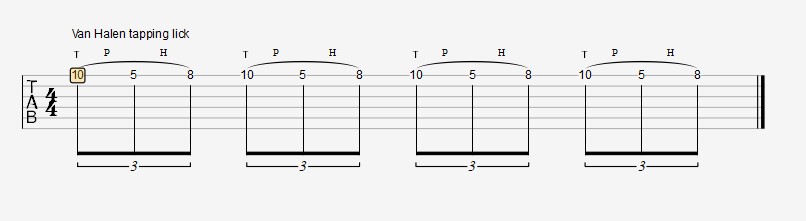
When I was younger , I learnt two-handed tapping using the typical Van Halen style lick:

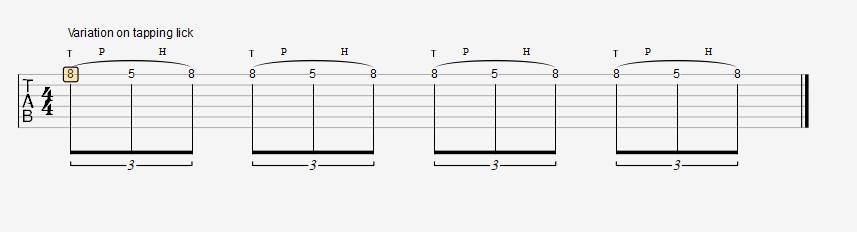
I then thought of different ways to make it unique. One was to tap and hammer onto the same fret, giving a kind of double-tap sound:

Whilst this isnโ€™t exactly an earth-shattering innovation, it does show that you can add your own twist on a technique. If you can create ten variations of every technique, you will start to develop your own unique style.

Let me know in the comments what technique you are working on and how you can make it unique.


My latest book ‘Guitar Gymnasium: Habits, Hacks and Tricks to Accelerate Your Playing‘ is available on Amazon now.

How to Learn Songs Faster (and remember them for longer!)

When I started learning the guitar, my learning process for a  new song was โ€œFirst fret, sixth string…move this finger to the first fret, fifth stringโ€ฆ then slide it up to the third fretโ€ฆโ€

Thereโ€™s nothing wrong with this โ€“ itโ€™s how we all learn in the beginning. As I learnt more songs and studied music theory, I developed better ways to learn pieces more efficiently.

1.Sequence

Just because we listen to music from start to finish, doesnโ€™t mean we have to start learning a piece from the beginning. My preferred method is to listen to the whole piece first and identify the tricky parts; if there is a difficult lick in the solo, for instance, you can start practising that now whilst learning the rest of the piece alongside it. We can master things quickly by learning them in parallel, rather than sequentially.

2. Give yourself a deadline and stakes

I find myself more motivated to learn something if there is a definite deadline and some sort of pressure or stakes involved. If I know I will be performing a song in a gig, the pressure will motivate me to make sure I learn the piece thoroughly and to a higher standard. Other ways to motivate yourself might be to play the song to some friends, teach the piece to someone else, or upload a video to YouTube.

3. Tempo

It might sound obvious, but practicing with a metronome really helps me to stay focussed on my timing as well as gradually building speed on any difficult sections. Once I can play the piece at the correct speed, I will then play along to a backing track to improve my musical feel.

4. Technical ability

This refers to how well your fingers are connected to your brain. Developing this should be a daily part of your routine, usually by playing exercises, but you can also use the piece you are currently learning to develop your technique: if you are struggling with a legato lick or a particular chord change, you can make this into an exercise by playing it slowly with aย  metronome and gradually speeding it up. Also try moving the pattern around the neck or onto different strings. Many of the musical patterns we encounter will repeat in various other songs, so it all helps to build our musical repertoire and makes it easier to learn future pieces.

5. Sing as you play

When you are learning something new, sing along with what you are playing on the guitar. I started doing this when I was learning a lot of solos and it really helped me build the connection between my fingers and my ear, meaning I could learn the solos quicker and also remember them for longer. If you are learning a chord progression, you could either sing the root notes of the chords you are playing, or you could sing the whole arpeggio.

6. Look for familiar patterns

If I really understand what I am playing from a music theory perspective, I find I can learn it faster and remember it for longer. By having a solid understanding of theory, you will be able to analyse the scales which are being used and also the harmonic framework of the chord progressions. Most songs follow very similar chord patterns, so understanding common progressions likeย  ii-V-I , I-IV-V, and I-vi-IV-Vย  allow me to โ€œchunkโ€ the piece into familiar patterns, so I donโ€™t need to reinvent the wheel each time I learn a new piece.

DEVELOPING AN EFFECTIVE PRACTISE ROUTINE Part-Two: Turning Weakness into Strength

Often when we sit down to practise, we actually end up playing. Practising means working on the things we canโ€™t yet play.

Playing is really important, after all that is why we practise so much in the first place and ripping through some solos is really fun and satisfying. Practising – like the large section of iceberg that sits under the water –  is the part no-one else ever gets to see.

The purpose of practising is to find our weak spots and turn them into our strengths, but this is the part that can be challenging. Psychologically it is difficult to admit that we are not perfect.

In his autobiography โ€˜Total Recallโ€™,  Arnold Schwarzenegger mentions how as a teenager he never worked on his calf muscles, with the result that he had a great upper body, but skinny calves. Some of his early photos even had him standing in water so his legs couldnโ€™t be seen. When he later decided to work on his calf muscles he would wear shorts all the time, showing the world his weak spot and often being ridiculed by other bodybuilders in the gym. But he knew this would give him the motivation he needed and eventually his calf muscles became one of his strengths.

Identifying Your Weak Spots

A good to find your weak spots is by learning lots of songs. I always use a backing track for the song Iโ€™m learning, as it ensures I stay in time and learn the music at the right speed. Playing without a backing, itโ€™s easy to unintentionally slow down at the fast bits and fool yourself that youโ€™re playing it at the right speed.

As I play through the song I highlight the difficult sections, then use a metronome to find the current speed I can comfortably  play them, writing this tempo on the tablature.

I turn each tricky section into an exercise, playing it in isolation with a metronome, gradually building up speed and accuracy, and marking my new speeds on the tablature. This may take many weeks, but you can see your improvements in the new speed markings. You can even record yourself each day to hear yourself improving.

Itโ€™s important to decide on the most comfortable fingering at an early stage, as you want to use consistent fingering to maximise your practise time. Once the tricky part is at the correct speed and feels comfortable, you can put it back into context and play along with the backing track. Record yourself and listen back: does it flow? If it is a fast part that you find tricky, build up speed until you can play it a little faster than the actual tempo; when you play it at the normal speed it will feel easier.

When you find a weak spot in your playing, try to identify the underlying cause of the difficulty. For instance if you have difficulty switching from a D chord to an A chord, play really slowly and watch what your fingers are doing. Can you play each chord on its own? If not, practise each chord in isolation. This is the idea of โ€˜tightening the circleโ€™ where we start with the biggest movements and gradually refine them in smaller and smaller detail. This concept is mentioned in the excellent book  โ€˜The Art of Learningโ€™ by Josh Waitzkin, who is a chess master and martial arts champion. The smaller we make our circle, the faster we can target our weaknesses and turn them into strengths.

Play with Other Musicians

Another great way to find your weak spots is by playing with other musicians. A major benefit is that you will be exposed to songs you may not usually listen to: if you are mainly a rock player, but you are asked to solo over some jazzy chords you may realise that you arenโ€™t comfortable soloing outside of a pentatonic solo.  Or you may realise that your rhythm playing isnโ€™t quite as tight as you thought it was. Or you may discover a new love for Latin Disco Techno-Funk!

When I was a teenager playing in my first band, we used to learn songs from CDs and tapes. I realised that my ear wasnโ€™t very good at identifying chord progressions, so I started making my own ear-training tapes to improve my relative pitch. I would never have done this if Iโ€™d just stuck to learning songs from tablature.

Emulate Your Heroes

Find a backing track to one of your favourite guitar solos and then emulate the solo, but donโ€™t copy it note-for-note. Just copy the overall shape of the solo.  I tried this with Zakk Wyldeโ€™s solo from โ€˜No More Tearsโ€™ by Ozzy Osbourne, following the overall shape of:

  • Smooth melody (starts at 4 minutes 13 seconds into song).
  • Aggressive pentatonic solo (starts at 4 minutes 41 seconds).
  • Climactic build up, using ascending legato patterns (starts at 4 minutes 56 seconds).

I realised that I found it difficult to use fast pentatonic patterns to build to a climax, mainly because I didnโ€™t know my pentatonic scales well enough across the entire neck. I had discovered my weak spot and could begin making it a strength.

Steal from your heroes

Once you have learnt a new solo, take some of the licks and write ten variations to use in your own solos. When we engage with the things weโ€™ve learnt it makes us process it in a deeper way and helps us retain it for longer. This makes our new knowledge โ€œdisfluentโ€, meaning its more difficult to initially absorb, but is more memorable for our brains. See the book โ€˜Smarter, Better, Strongerโ€™ by Charles Duhigg for a great chapter on this.

Practise with โ€œEmotional Contentโ€

Bruce Lee said it is better to practise a punch once with focus than practise a punch one hundred times with no focus. He called this โ€œemotional contentโ€ and we can apply this by practising with our full attention. Allocate a realistic time period for your practise session with a clearly defined goal (i.e. โ€œIโ€™m going to practise for 25 minutes and learn an A Major 7 arpeggio in five different positions on the neckโ€. This will help you maintain focus. Make sure you have a break when the time limit is up as it is vital to rest your hands and mind.


One of the great things about music is that it is a life-long endeavour and we all have areas that we can improve. Never let your weaknesses discourage you, as each weakness is a gift that will push you closer to being the best musician you can be.