“It is rarely a mysterious technique that drives us to the top, but rather a profound mastery of what may well be a basic skill set.”
Josh Waitzkin – The Art of Learning
Whenever we start learning a new skill – whether it’s
yoga, martial arts or a new instrument – we naturally measure our progress in
terms of how much we know: learning more scales, more techniques, more songs and
more licks gives us a great sense of progress and makes us feel like we are
getting better.
Usually, however, we are not. In fact, I recently learnt
that doing the exact opposite can elevate your skills to a much higher level.
When I was a teenager learning the guitar, I was obsessed with how many scales I could learn: harmonic minor, Phrygian dominant, Japanese pentatonic scales. I really believed that the more scales I knew, the better a guitarist I would become. When I later started playing in a band, I realised most of these scales were totally impractical and redundant. Not only that, but because I was cramming as many scales as possible into my brain, I had learnt them all in a very superficial way and usually in only one position on the neck. I was making the common error of over emphasising the quantity of what I was learning, and not developing the depth and quality of what I was learning.
In his excellent book ‘The Art of Learning’, Josh Waitzkin discusses the idea of “making smaller circles” – a concept he used to become a chess champion and then a martial arts master.
The principle of “making smaller circles” is to start
with broad movements which are then gradually narrowed and refined. In chess
this might mean that you start learning the End Game first, with only a few
pieces on the chess board. When learning a new guitar solo, this might mean playing
through the solo once and highlighting the difficult sections, before narrowing
those sections further to isolate a particularly tricky phrase, and then narrowing
further again to a small sequence of notes.
Once I have zoomed in and identified a problem, I usually
find that the stumbling blocks are just a handful of notes or a particular
technique that needs to be drilled repeatedly as an exercise.
Refining one small element can then have a massive impact on your overall skill,
elevating everything else onto a new level.
“Making smaller circles” is something that Steve Vai uses in his own practicing, where he focusses on a narrow technique for an hour and tries to expand and develop that technique. An example of this is where he focussed on his finger vibrato for an extended period and realised that he could combine the typical Rock vibrato (i.e. bending and releasing the string) with Classical vibrato (sliding your finger up and down within the fret) to create his own distinctive ‘circular’ vibrato.
Although I wasn’t previously aware of the “smaller circles” concept, I often applied it intuitively when teaching others. When I recently taught someone how to play ‘Stairway to Heaven’ by Led Zeppelin, he was struggling with the chord changes in the introduction. He had been practising the song at a slow-tempo with finger picking, as it sounds on the record. I suggested he isolate the chord changes by strumming each chord once, whilst playing the chord sequence in a repetitive loop. This meant we could focus on improving the speed of the left-hand chord changes without using lots of cognitive space worrying about the right-hand finger-picking. Strumming the chords also took half the time as finger-picking, so we could get more repetitions into a practice session, again “making the circle smaller”.
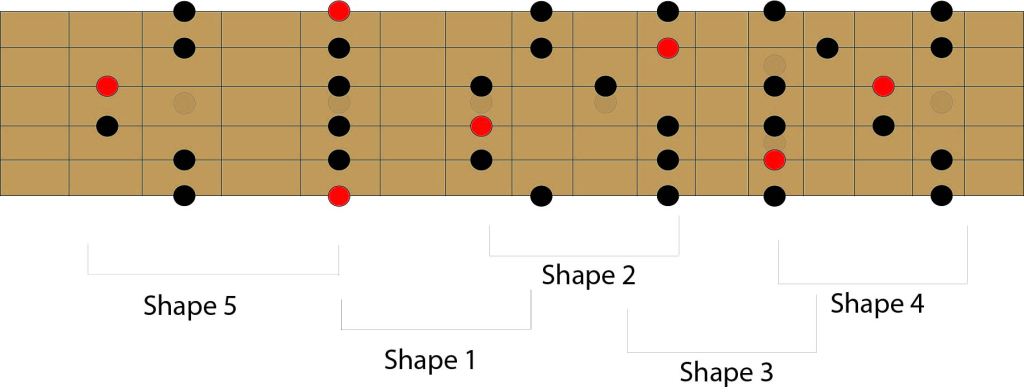
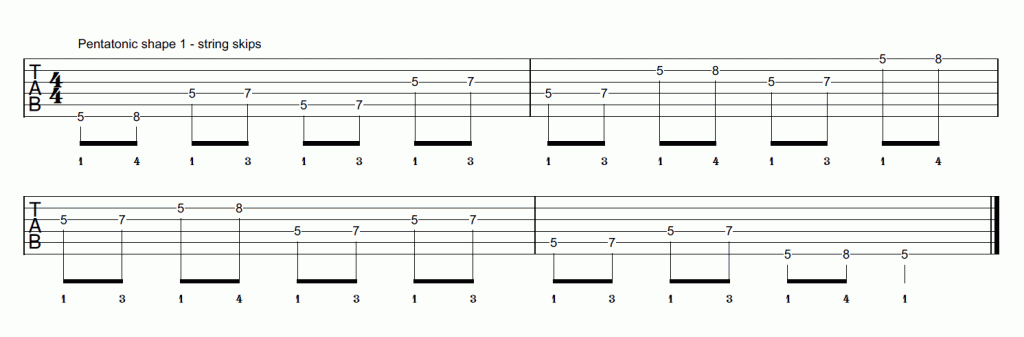
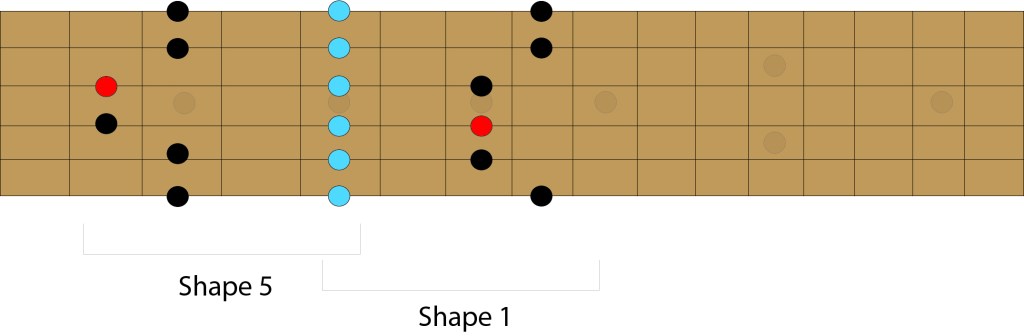
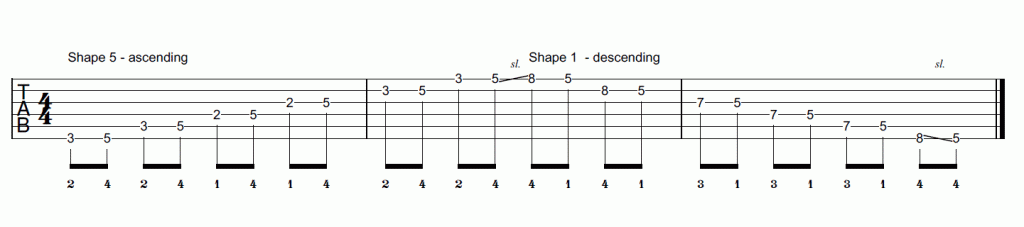
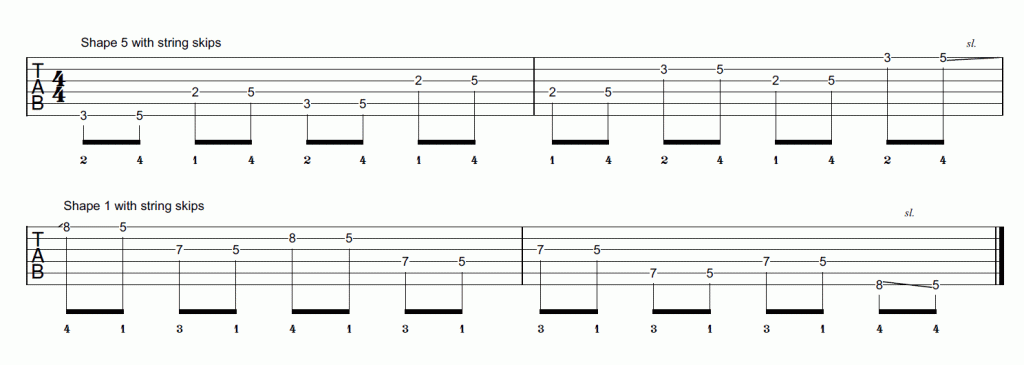
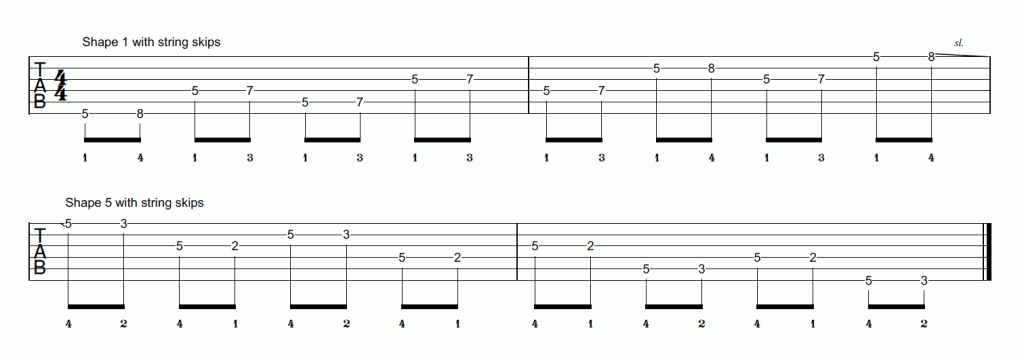
In my own learning, I realised recently that my knowledge of pentatonic scales was a little superficial, partly because I’d spent my teenage years learning loads of fancy scales that were not as useful as the humble pentatonic. I decided I would “make the circle smaller” and concentrate on learning the pentatonics deeply, mastering them in all five positions across the entire neck. I came up with a host of different techniques to really understand the pentatonics and internalise the feel and sound of them rather than just trying to ‘shred’ through them. I looked at where the root notes occur within each shape; where the major or minor tonic chords are within each pattern; I also sang the scales as I played; I would improvise a lick, then try to play it in each pentatonic shape across the neck. I also looked at how far I could bend notes whilst staying within the pentatonic scale.
After all this in-depth pentatonic practice, something strange happened. My student was ready to learn the ‘Stairway to Heaven’ solo and I said “yeah, that’s fine, I’ve played it loads of times – it’s all pentatonic scales”.
Only it’s not.
As I was playing the first bars of the solo, I realised that Jimmy Page steps outside the pentatonic scale to play an ‘F’ note. I thought: “Hmmm, I’ve never noticed that before. Why does he do that?”
I realised that by moving outside the pentatonic, Page gives the solo an added sophistication, highlighting the root note of the F Major 7 chord he is playing over, even though he could have stayed within the pentatonic scale and it would have sounded fine. I then looked more closely to see if he always played the ‘F’ note each time this chord arrived and I saw that he later plays the unusual note of ‘G’ over this chord (the ‘G’ is in the pentatonic scale but is not in an F Major 7 chord, so the note functions like a jazzy major 9th). I began to see all the nuances I had previously missed when I first learnt the solo, as I had superficially assumed it was all pentatonics and didn’t have the deep knowledge of pentatonics to realise otherwise. I had made my circle smaller.
So, if you really want to improve your playing, focus deeply on one thing and explore it fully before moving on. You will find that this new-found mastery spills over into other aspects of your playing, giving an extra dimension to your knowledge and musicality.
My latest book ‘Guitar Gymnasium: Habits, Hacks and Tricks to Accelerate Your Playing‘ is available on Amazon now.





 Impact Guitar